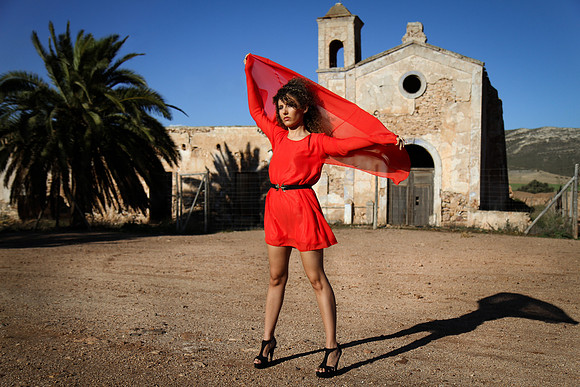
Cortijo del Fraile, Almería, Andalucía.
This series was shot at the infamous
Cortijo del Fraile, near to the village of
Nijar in the province of
Almería. The history of this present day ruin is fascinating and had some influence on the designing of the shoot. Model is
Marta Moslw.
Built in 18th century by Dominican monks, the
Cortijo del Fraile farm complex sat central to several smaller farmsteads situated in the vicinity. Serving as a homestead and agricultural workcentre the complex also included a chapel, bell tower, funerary crypt, bakery and fresh water collection system. The
Cortijo del Fraile serves as an evocative reminder of the profound history of this region's agricultural heritage. However, due to events occurred here on the 22nd of July 1928, the
Cortijo leapt onto the front pages of Spanish newspapers and subsequently - due to the Spanish playwright Gabriel Garcia Lorca - assumed a place in Andalusians' collective cultural consciousness.
The events in question became known as the
Crimen de Nijar (Crime of Nijar) and broadly occurred as follows:
In the summer of 1928 a young local woman by the name of Francisca Cañada was due to be married - in the C
ortijo'schapel - to a local argicultural labourer called Casimiro Perez Pino. The young woman was allegedly carrying a large dowry and the families were said to be pleased with the marriage. However, it resulted that Francisca herself was disenchanted by the idea of marrying Casimiro and had, in fact, fallen in love with her own handsome cousin, Curro. Following a furious argument with her fiance on the eve of the marriage day, Francisca decided to run away from her seemingly bleak future with Casimiro and escape with Curro. Unfortunately for the enamoured couple, they were apprehended by Casimiro's brother Jose while sneaking out through the chapel. Realising that Francisca and Curro were fleeing, Jose grabbed his gun and, in the name of his family's honour, shot Curro dead on the spot.
The dramatic killing became national news when it made the front page of the Heraldo de Madrid newspaper a few days after the event. The mixture of romance, drama and death ensured that there was public intrigue in the story and one curious reader - it transpired - was the
Granadinoplaywright Gabriel Garcia Lorca, who used the murder as inspiration for his 1932 play
Bodas de Sangre ( Blood Wedding). The play, which explores themes of fate, choice, nature and the passing of time is now routinely performed all over the world and is considered one of the pillars of Spanish theatre. Extra gravitas is, of course, now read into any performance of the play due to Lorca's own tragic demise, at the hands of nationalist militia in 1936.
A further fascinating part of the
Cortijo del Fraile's legacy comes from its appearance in Sergio Leone's classic western
The Good, The Bad and the Ugly. Outside of Spain, it isn't widely known that the area around
Nijar (and the province of
Almería in general) was used extensively in filming many of the great Spaghetti Westerns of the 1960s. However, the local landscape's similarity to the arid American West brought cash-strapped filmmakers to the region and many of the genre's most iconic works were filmed here. The Cortijo del Fraile's appearance in
The Good, The Bad and The Ugly can be seen by clicking the link. The
Cortijo is imagined, in the movie, as a complex of similar purpose to it's own real-life history, only many thousands of miles away. In the clip you can see a worse-for-wear Blondie (Clint Eastwood) arriving at Father Ramirez's monastery (The
Cortijo del Fraile). In the subsequent clip Blondie and Tuco (Eli Wallach) roll out with the
Cortijo in the background.