Bullring
Las Ventas, Madrid, Spain.
The tradition of fighting bulls on foot has endured in Spain for almost 300 years. Though some would argue that the practice is in decline (it was outlawed in the province of Catalonia in 2010), there is no doubt that bullfighting remains popular in its traditional heartlands of central Spain and Andalusia. Despite political pressure (former Spanish prime minister Jose Luis Zapatero believed it was incongruous with notions of a progressive Spain) and dissenting voices from animal rights activists, the sport - some would say art - of
tauromaquia shows no sign of disappearing from Spanish television or newspapers any time soon.
I have visited Madrid's
Las Ventas bullring - Europe's most prestigious arena - on three or four occasions, and though I have never left as a bullfighting convert, I can't deny that the spectacle has always provided a certain fascination to me. I refer not merely to the protagonists of the day, but also to the piercing brass of the musicians, the weathered faces of the
ganaderos (bull farmers), the fidgeting of nervous assistants, the cordiality of the well-dressed madrileños and, not least of all, the sense of history that quietly envelops all who enter the magnificent
Mudéjar amphitheatre.
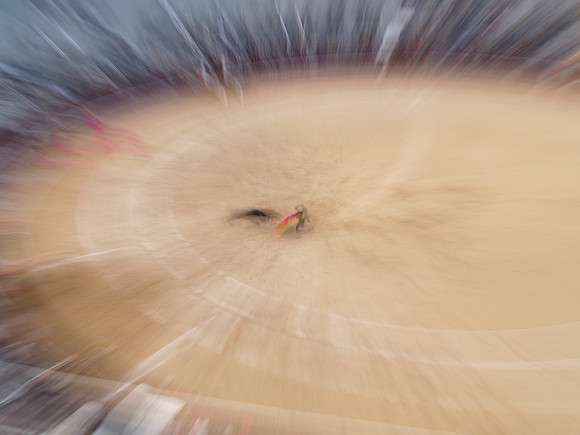
The above photo, however, tries to capture the focus that naturally falls on the matador and bull when the final act of the bullfight is played out. The sense of protagonism and isolation is, I think, adequately conveyed. Also, though the scene is evidently blurred (perhaps veiling the suffering of the doomed animal in favour of Hemingwayan romantiscism?), the smudge of bright pink immediately signals to the educated eye that a bullfight is taking place. A Spaniard will always relate this specific shade of fuchsia with the capote / cape. My favourite aspect of this photograph, however, it that as well as conveying the deadly dance of bull and bullfighter, the black smear of the former also brings to mind the smokey sketches of paleolithic cave paintings from sites like
Altamira, in northern Spain, or
Lascaux, in France.
Pablo Picasso's sketches and engravings of fighting bulls - often abstracted - also act as a point of reference.